
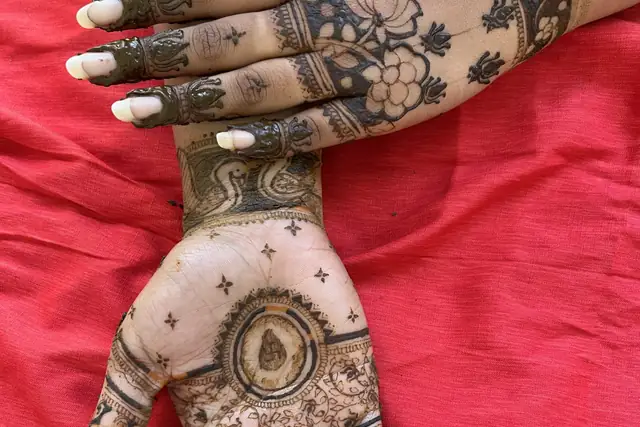
To plan a henna night, start four to six months before the wedding: choose the tradition you want to honour, set the date a few days to a week before the wedding, book a venue and the key people (the dresser, the musicians, the henna artist or the family member who will apply it), then build the evening around the bride's entrance and the henna ritual. This complete guide covers every step, from the meaning of the ceremony to the music, outfits, food, budget and running order.
A henna party, also called a henna ceremony or simply "the henna", is one of the most joyful pre-wedding celebrations in Moroccan, Tunisian, Yemenite, Iraqi, Kurdish, Libyan and many other Jewish and Middle Eastern families, and it has become very popular in Israel and France, even among couples with no henna tradition in the family. Done well, it is often the party guests remember most.
What is a henna night?
A henna night is a celebration held before the wedding during which henna, a natural reddish dye made from the leaves of the henna plant, is applied to the bride, and often the groom, to bring luck, fertility and protection against the evil eye. The ceremony marks the passage from the parents' home to married life, with songs, blessings, traditional costumes and a lot of sweets.
The form changes from one community to another:
- Moroccan families celebrate with a grand embroidered dress, ululations, a parade of the couple, and a dab of henna in the palm, often with a coin or a piece of gold.
- Yemenite brides wear one of the most spectacular costumes of the Jewish world, a heavy gold-embroidered outfit with an elaborate headdress, while women sing traditional songs.
- Tunisian, Libyan and Iraqi families each have their own songs, dishes and outfits, sometimes with several costume changes.
- South Asian families hold a mehndi, where intricate designs are drawn on the bride's hands and feet over several hours.
To go deeper into the meaning and history, read our article on henna ceremony traditions explained, and if your family is Moroccan, our dedicated Moroccan henna ceremony guide.
Step 1: Decide what kind of henna you want
Before booking anything, talk as a couple and with both families. Three questions shape everything else:
- Which tradition? A Moroccan henna, a Yemenite henna, a mix that honours both families, or a modern "henna party" inspired by several cultures. If the bride is Moroccan and the groom Yemenite, many couples alternate songs and costumes from both sides.
- Who is it for? A close-knit evening with 40 relatives, or a big party with 200 guests that almost feels like a second wedding?
- How traditional? Some families want every ritual, the elders' songs and a specialised dresser; others want a party with a short henna moment and a DJ.
There is no wrong answer, but deciding early prevents misunderstandings with parents and grandparents who may have strong expectations.
Step 2: Choose the date
Traditionally, the henna takes place a few days to a week before the wedding, often mid-week. In Israel, many couples hold it on a weekday evening one or two weeks before. Avoid:
- the night just before the wedding, unless you are sure you can handle two late nights;
- a date that is too far from the wedding, which loses the "countdown" spirit;
- religious constraints: Shabbat, festivals and, for many families, the Omer period between Pesach and Shavuot and the Three Weeks in summer, when celebrations with music are avoided according to custom.
Step 3: Build a timeline
| When | What to do |
|---|---|
| 6 months before | Decide the format and tradition, set the budget, draft the guest list |
| 5 months | Book the venue or tent, the caterer and the musicians or DJ |
| 4 months | Book the dresser or costume rental, the henna artist, the photographer |
| 3 months | Choose outfits and fittings, plan decoration, order trays and accessories |
| 6 to 8 weeks | Send invitations |
| 3 to 4 weeks | Follow up RSVPs, build seating, confirm the running order with all vendors |
| 1 week | Final numbers, prepare henna kits and favours, brief the family helpers |
| The day | Give one person the role of coordinator |
Step 4: Set your budget
The cost of a henna night varies hugely depending on the number of guests and on whether you choose a hall, a restaurant or a garden. Indicative ranges, to adapt to your city:
| Item | Indicative range | Notes |
|---|---|---|
| Venue | from free (family home) to several thousand euros | Halls often include catering |
| Catering | 25 to 70 euros per person | Sweets and pastries are a major item |
| Costume rental and dresser | 300 to 2,500 euros | Depends on number of outfits and helpers |
| Music | 500 to 3,000 euros | DJ, darbouka player, traditional band |
| Henna artist | 150 to 800 euros | Simple palm dab versus detailed designs for many guests |
| Decoration | 300 to 3,000 euros | Tent, cushions, lanterns, bridal seat |
| Photo and video | 400 to 2,000 euros | Often the same team as the wedding |
Many couples share the cost between both families, or the bride's family hosts the henna while the groom's family focuses on other events. Whatever you choose, track every quote and deposit in one place. Mazaly's budget tool lets you separate the henna from the wedding budget while sharing both with the people who pay.
Step 5: Choose the venue
Popular options:
- The family home or garden: authentic and intimate, perfect for up to 50 or 60 guests.
- A hall or event space: practical for big families, often with in-house catering and sound.
- A restaurant with Moroccan or Middle Eastern decor: the atmosphere is already there.
- A rented tent with rugs, poufs and low tables, very common in Israel.
- A villa or rooftop for a more modern feel.
Check the essentials: space for a bridal stage or a raised seating area, a separate room for outfit changes, a dance floor, noise restrictions for late music, parking and accessibility for grandparents.
Step 6: Outfits, dresser and costume changes
Outfits are a highlight of the evening. In Moroccan families, the bride may wear a caftan, a takchita or the grand embroidered dress known as the "keswa el kbira", with jewellery and a headpiece. In Yemenite families, the bridal costume is assembled piece by piece by experienced women. Many brides plan two or three changes during the evening.
Book the dresser early: the good ones are taken months ahead in the wedding season. Plan a fitting, a list of accessories, and a quiet room with a mirror and good light. The groom traditionally wears a djellaba, a gandoura or a matching outfit, and many families offer costumes to close relatives. Guests often come in caftans or festive clothing in rich colours. Our guide on henna outfits and what to wear covers looks for the bride, the groom and the guests.
Step 7: The henna itself
Who applies the henna
In many Jewish families, the henna is applied by the grandmother, the mother of the bride or an elder woman of the family, sometimes the mother of the groom, as a blessing. It is often a simple round of henna placed in the palm of the hand, wrapped with a ribbon or a cloth, and then offered to guests on a small square or a leaf for luck. Unmarried girls in some families take henna in the hope of marrying soon.
Hiring a henna artist
If you want detailed designs, for the bride or for guests who would like a small pattern, hire a professional henna artist. Check that they use natural henna without chemical additives, especially "black henna", which can cause severe skin reactions. Ask to see recent photos, ask how many guests they can serve per hour and do a skin test beforehand. Our guide on how to choose a henna artist lists the questions to ask.
The henna tray
The henna is usually carried in on a decorated tray, with candles, flowers and sometimes eggs or sugar for symbolism, in a procession with singing and ululations. Prepare the tray in advance and decide who will carry it.
Step 8: Music and entertainment
Music makes the henna. Most families combine:
- Traditional music: darbouka, oud, violin, Andalusian or Moroccan songs, Yemenite songs sung by the women of the family;
- A DJ for Mizrahi pop, Israeli hits, Middle Eastern and international dance music;
- Dancers or a traditional troupe for the processions;
- The carrying of the couple, in some families on a decorated chair or a platform.
Plan when each moment happens so the evening has peaks of energy and calmer times for the meal and blessings. For more ideas, see our henna music and entertainment guide.
Step 9: Decoration and atmosphere
The henna is the event where you can be bold with colour: deep reds, gold, emerald, orange, jewel tones. Classic elements:
- a bridal stage or an armchair "throne" with cushions and a backdrop;
- rugs, poufs and low tables for a lounge atmosphere;
- lanterns, candles and warm lighting;
- brass trays of sweets, dates and dried fruit;
- flowers in bold colours;
- a photo corner with costumes for guests.
Our article on henna decoration ideas and themes gives five complete themes, from traditional Moroccan to bohemian garden.
Step 10: Food and sweets
Sweets are central to the symbolism of the henna, wishing the couple a sweet life. Typical Moroccan and North African tables include almond pastries, gazelle horns, date-filled cookies, nougat, sugared almonds and mint tea, alongside a full meal: salads, couscous, tagines, grilled meats or fish. Yemenite tables may feature jachnun, malawach and spiced coffee. Plan a dedicated sweets table and a tea service: they are part of the show.
If the wedding is kosher, keep the henna kosher too, so all family members can eat.
Step 11: Invitations and guest list
The henna guest list is usually smaller than the wedding list, focused on family and close friends, but in some families it is just as big. Decide early whether everyone invited to the henna is also invited to the wedding, and keep both lists in one shared file to avoid mistakes.
Send invitations six to eight weeks before, mention the dress code (traditional outfits welcome, costumes available), and specify whether children are invited. Digital invitations work very well for henna nights, with the map, the dress code and a reply button. With Mazaly's online invitations, each reply updates your list automatically, and reminders go out on WhatsApp in one tap to those who have not answered.
Favours for guests
Guests often leave with a small souvenir that echoes the evening: a box of almond pastries or sugared almonds, a small pouch of natural henna, a mini hamsa, a bottle of orange blossom water or a tea glass. Choose one item, personalise it with the couple's initials and the date, and place it near the exit so everyone takes one.
Step 12: The running order of the evening
Here is a typical flow for a Moroccan-inspired henna night. Adapt it to your tradition:
| Time | Moment |
|---|---|
| 19:30 | Guests arrive, welcome drinks and sweets |
| 20:15 | First entrance of the couple in traditional outfits, procession with music |
| 20:45 | First course, family toasts |
| 21:15 | Henna ritual: procession of the tray, application by the elders, blessings, henna for guests |
| 21:45 | Outfit change, dance set |
| 22:30 | Main course |
| 23:00 | Second entrance or carrying of the couple, dancing |
| 23:45 | Sweets table, tea, end of the evening |
For a detailed description of each ritual and its order, read our guide on henna ceremony flow and rituals. Share the running order with the DJ, the dresser, the photographer and the caterer, so outfit changes do not clash with the meal.
Mistakes to avoid
- Booking the dresser too late: in wedding season they are reserved months ahead.
- Using black henna or products with unknown ingredients.
- Forgetting the changing room and the time each outfit change takes, often 20 to 30 minutes.
- A henna too close to the wedding, leaving the couple exhausted.
- Not briefing the elders: grandmothers often know songs and rituals that should be included; ask them before the evening.
- One guest list for two events, with confusion over who is invited where.
Organising it all in one place
A henna night has many moving parts: two families, several vendors, outfits, a running order and a guest list that overlaps with the wedding. Mazaly is a free app, on iPhone and on the web, where you can manage the guest list and replies, send online invitations, keep a checklist and budget, build a timeline for the evening and share everything with your family. You can find decorators, caterers and musicians in the vendor directory, and for the wedding itself, follow our guide on how to plan your wedding step by step.
Conclusion
A henna night works when it honours the family's tradition and still looks like the couple. Decide the format together, book the dresser and the musicians early, keep the henna ritual at the centre of the evening, and plan the running order so the outfit changes, the meal and the dancing flow naturally. Then let the music, the colours and the blessings do the rest.
Frequently asked questions
What happens at a henna night?
The bride, and often the groom, make an entrance in traditional outfits, the henna is carried in on a decorated tray with singing and ululations, and an elder of the family applies it to their palms as a blessing. Guests often receive a little henna for luck. The evening continues with a meal, sweets, dancing and sometimes several costume changes.
How long before the wedding is the henna?
The henna usually takes place a few days to a week before the wedding, sometimes two weeks in Israel. Avoid the night just before, which leaves the couple tired on the wedding day. Also check religious dates, such as Shabbat, festivals and periods when many families avoid celebrations with music.
Who pays for the henna party?
Traditionally the bride's family often hosts the henna, but today it is very common for both families to share the cost, or for the couple to pay. The important thing is to agree early, especially if the henna and the wedding are planned with separate budgets.
What do guests wear to a henna?
Guests are encouraged to wear festive, colourful clothing, and women often wear a caftan or traditional dress. Many hosts offer costumes or accessories at the entrance for those who do not have one. Avoid white, which is reserved for the wedding day in many families.
How much does a henna night cost?
As an indicative range, a family henna at home with catering can stay at a few thousand euros, while a henna for 150 to 200 guests in a hall with a dresser, musicians and a photographer can reach a budget close to a small wedding. Guest count and catering are the biggest factors.
Is black henna safe for a henna ceremony?
No. So-called black henna often contains chemical dyes that can cause serious allergic reactions. Use only natural henna, which gives an orange to reddish-brown colour, and ask your henna artist for the ingredients and a skin test before the event.