
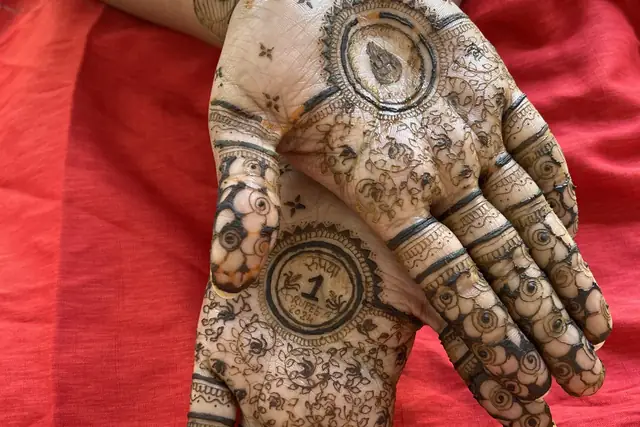
To choose a henna artist, start three to six months before the event, compare portfolios with recent photos of real clients, check that they use only natural henna with listed ingredients and never "black henna", ask how many guests they can serve per hour, and agree in writing on designs, timing, price and travel. This guide explains what a henna artist does at a henna night or a mehndi, the questions to ask, how pricing works, safety rules and how to fit the artist into the evening's timeline.
In many Jewish families, the symbolic henna is still applied by a grandmother or the mother; a professional artist adds detailed designs for the bride and guests. For the full organisation, see our complete guide to planning a henna night.
Do you need a henna artist?
It depends on your tradition and your wishes:
- Traditional Jewish henna (Moroccan, Yemenite, Tunisian...): the ritual henna is usually a simple ball of henna placed in the palms by an elder. You do not need a professional for that; you need good quality henna paste, which an artist or a specialist shop can prepare.
- Detailed bridal designs: if the bride wants patterns on her hands, wrists or feet, hire a professional.
- Henna for guests: a henna artist at a "henna corner" is a popular entertainment, offering small designs throughout the evening.
- South Asian mehndi: the bride's designs are elaborate and can take several hours; an experienced artist is essential.
When to book
Book three to six months in advance, more in wedding season. For bridal designs that take a long time, the artist may come the day before or a few hours before the henna, because the paste needs time to dry and the colour develops over 24 to 48 hours.
Where to find a henna artist
- Recommendations from friends and family who recently held a henna.
- Social media portfolios, using searches like "henna artist" plus your city.
- Your dresser, decorator or DJ: henna professionals often work together.
- Event directories such as the Mazaly vendor directory.
Evaluate the portfolio
Look beyond the most beautiful photo:
- Recent work, ideally from the last few months.
- Photos of fresh paste and of the final stain a day or two later: the colour of the stain shows the quality of the henna.
- Variety of styles: Moroccan and North African geometric patterns, Arabic floral designs, Indian mehndi, minimalist modern designs.
- Consistency: clean lines, even thickness, symmetry.
- Real clients, not only demonstration designs on the artist's own hands.
- Event photos, to see how they work with many guests.
Safety first: natural henna only
This is the most important point. Natural henna stains the skin from orange to reddish-brown. So-called "black henna" often contains a chemical dye (para-phenylenediamine, or PPD) that can cause severe allergic reactions, burns and lasting skin sensitivity. Avoid it absolutely.
Ask the artist:
- What exactly is in your paste? (Natural henna is usually henna powder, water or lemon juice, sugar and essential oils.)
- Do you make the paste yourself, fresh?
- Which essential oils do you use? (Some can irritate sensitive skin; ask about alternatives for pregnant guests and children.)
- Can you do a patch test a few days before?
Also avoid "instant" henna cones that stain dark within minutes: they often contain additives.
Questions to ask before booking
- What styles do you specialise in?
- How long does a bridal design take for hands only, hands and feet?
- How many guests can you serve per hour, and how detailed are guest designs?
- Do you bring an assistant for large events?
- What do you need on site: table, chairs, lighting, space?
- Do you offer a trial session for the bride?
- What is your price structure: per hour, per person, per design, package?
- What are your travel fees?
- What is the deposit and cancellation policy?
- What aftercare do you recommend?
Understanding henna artist pricing
| Service | Indicative range | Notes |
|---|---|---|
| Ritual henna paste only | 30 to 100 euros | Fresh paste for the elders to apply |
| Simple bridal design, hands | 80 to 250 euros | Depends on detail |
| Full bridal design, hands and feet | 200 to 800 euros | Can take 2 to 6 hours |
| Guest henna corner, per hour | 60 to 150 euros | Small designs, 8 to 15 guests per hour |
| Package for bride and guests | 300 to 1,200 euros | Often includes travel locally |
These ranges are indicative and vary by city, experience and complexity. Compare offers on the same basis: number of hours, number of guests, travel, assistant.
Discuss designs and expectations
- Share inspiration: photos of designs you like, and those you do not.
- Decide placement: palms only, back of the hands, fingers, wrists, feet.
- Personal touches: initials of the couple hidden in the pattern, a hamsa, a Star of David, a date. Many artists love to include them.
- Match the outfit: a design that harmonises with the embroidery of the caftan or the dress.
- Coordinate with the ritual: if a grandmother will place henna in the palm, the artist can design around it, on the back of the hand and the fingers.
Fit the artist into the timeline
The henna artist needs time and space:
- For the bride: schedule the bridal design the day before or early in the day, with time to dry before dressing.
- For guests: set up a henna corner with a table, two chairs, good light and a mirror, away from the dance floor but visible. Open it after the ritual, during the meal and the first dance sessions.
- Queue management: put a sign with the time slots or a simple sign-up sheet, so guests do not wait standing.
- Drying: guests need 15 to 30 minutes without touching anything; provide tissues and a drying spot.
Add the artist's arrival time, setup and working hours to the evening's timeline, and share it with the coordinator. In Mazaly, a free app on iPhone and on the web, you can keep the artist's contact, quote and schedule with the rest of your henna plan. For the order of the evening, read our guide on henna ceremony flow and rituals.
Aftercare tips to share with guests
- Leave the paste on as long as possible, at least two to four hours, ideally overnight for the bride.
- Let it dry and flake off naturally, or scrape gently; do not wash with water for 12 to 24 hours.
- A little lemon and sugar mix dabbed on the dry paste helps it stick.
- Apply a natural balm or oil once the paste is removed.
- The colour deepens over 24 to 48 hours and lasts one to three weeks.
Red flags
- No ingredient list or vague answers.
- "Black henna" or a promise of instant dark colour.
- Only stock photos or designs on their own hands.
- No contract or no clear price.
- Unwilling to do a patch test.
Conclusion
A good henna artist is safe, skilled and organised: natural henna with clear ingredients, a portfolio of real clients with final stains, a realistic pace for guests and a clear contract. Book early, do a patch test and a trial for the bride, design around the family's ritual, and plan the henna corner in the timeline. Then enjoy the designs, and the blessing they carry. For outfit coordination, see our guide on henna outfits and what to wear.
Frequently asked questions
How much does a henna artist cost?
As an indicative range, a simple bridal design on the hands costs 80 to 250 euros, a full design on hands and feet 200 to 800 euros, and a henna corner for guests 60 to 150 euros per hour. Prices depend on the city, the artist's experience and the complexity of the designs.
How far in advance should I book a henna artist?
Book three to six months before the event, and earlier in wedding season. Bridal designs are often done the day before or early on the day of the henna, so the colour has time to develop.
Is black henna safe?
No. Black henna often contains PPD, a chemical dye that can cause severe allergic reactions and burns. Use only natural henna, which gives an orange to reddish-brown colour, and ask your artist for the full list of ingredients and a patch test.
How many guests can a henna artist do per hour?
For small, simple designs, an artist typically serves 8 to 15 guests per hour, depending on the complexity. For a large event, ask whether they bring an assistant, and organise time slots so guests do not wait.
How long should henna stay on the skin?
Leave the paste on for at least two to four hours, and ideally overnight for the bride. Avoid water for 12 to 24 hours after removing it. The colour darkens over the next 24 to 48 hours and lasts one to three weeks.