
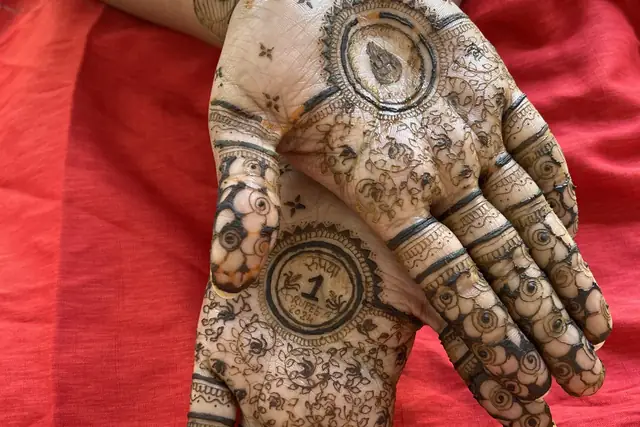
A henna ceremony is a pre-wedding celebration in which henna, a natural reddish dye, is applied to the bride, and often the groom, to bless the couple with luck, fertility and protection from the evil eye. It is a tradition shared by many Jewish communities from North Africa and the Middle East, including Moroccan, Yemenite, Tunisian, Libyan, Iraqi and Kurdish Jews, as well as Arab, Turkish, Persian and South Asian cultures, each with its own songs, clothes and rituals. This guide explains where the henna tradition comes from, what it means, and how customs differ between communities.
If you are planning one, our complete guide to planning a henna night covers budget, venue, outfits and the running order.
What is henna?
Henna comes from the leaves of Lawsonia inermis, a shrub that grows in hot, dry regions from North Africa to India. Dried and ground into a powder, then mixed with water, lemon juice or tea, it forms a paste that stains the skin and hair a colour ranging from orange to deep reddish-brown. The stain lasts one to three weeks and fades gradually.
People have used henna for thousands of years, for cosmetics, for cooling the skin in hot climates, for dyeing hair, nails, wool and leather, and for celebrations. Across the regions where it grows, it became associated with joy, beauty and blessings, and especially with weddings.
The meaning of the henna ceremony
Although customs vary, the henna carries similar meanings almost everywhere:
- Blessing and luck: the red colour is associated with joy and life.
- Protection: henna is believed in many folk traditions to protect the bride from the evil eye at a moment of transition.
- Fertility and prosperity: wishes for children and abundance.
- Transition: the bride leaves her parents' home and enters married life; the henna marks the passage.
- Community: women of the family, and sometimes the whole community, gather around the bride with songs and blessings.
In many communities, unmarried girls who receive a little of the bride's henna are wished a quick marriage, and guests take henna home as a sign of good luck.
Henna in Jewish communities
Henna is not a religious commandment in Judaism; it is a custom that Jews of North Africa, the Middle East and parts of Asia shared with their neighbours and gave their own form, with Hebrew blessings, piyutim (liturgical songs) and Jewish symbols. Since the great waves of immigration to Israel and France in the 20th century, the henna has become a beloved part of Israeli and French Jewish wedding culture.
Moroccan Jewish henna
The Moroccan henna is today the most widespread form in Israel and France. Typical features:
- the bride wears a richly embroidered dress, often the grand ceremonial dress known as the "keswa el kbira", with heavy jewellery and a headpiece;
- the couple enters in a procession with songs, darbouka and ululations (the "youyous");
- an elder, often the grandmother or mother, places henna in the palms of the bride and groom, sometimes with a coin or a piece of gold;
- the hands are wrapped with a cloth or ribbon;
- sweets, almond pastries and mint tea are served in abundance.
Our Moroccan henna ceremony guide explains it in detail.
Yemenite Jewish henna
The Yemenite henna is famous for the bridal costume, one of the most elaborate in the Jewish world: layers of embroidered garments, gold and silver jewellery, and a tall headdress decorated with flowers and aromatic herbs, assembled by experienced women of the family. Women sing traditional songs, often in Judeo-Arabic, accompanied by the beat of a copper tray or drum. The henna is applied to the bride's hands, and sometimes guests are given henna as well. The Yemenite henna can last a whole evening and was historically part of a multi-day wedding celebration.
Tunisian, Libyan and Algerian traditions
North African communities beyond Morocco have their own forms, with different songs, dishes and outfits. In some families, the henna is held over more than one evening, with different rituals for the bride and the groom. Customs vary from city to city; asking grandparents is often the best way to know what your family did.
Iraqi, Kurdish and Persian Jewish traditions
Iraqi Jews from Baghdad, Kurdish Jews and Persian Jews also held henna celebrations, with their own music, dress and foods. In some communities, the groom's henna was a separate event with the men of the family.
Indian Jewish communities
The Bene Israel community of India held a mehndi ceremony influenced by the surrounding culture, with the bride's hands decorated before the wedding.
Henna in other cultures
- Arab and Berber traditions across North Africa and the Middle East hold a "henna night" before the wedding, with songs, ululations and the bride in traditional dress.
- Turkish families celebrate the kına gecesi (henna night), often with emotional songs about the bride leaving her mother's home.
- South Asian cultures (India, Pakistan, Bangladesh) hold a mehndi ceremony, where intricate designs are drawn on the bride's hands and feet over several hours. A popular belief says that the darker the stain, the stronger the love.
- Persian weddings include henna in some regions as part of pre-wedding celebrations.
Common symbols and objects
| Symbol | Meaning | Where it appears |
|---|---|---|
| Henna paste in the palm | Blessing, luck, protection | Most Jewish and North African traditions |
| Coin or gold placed in the henna | Prosperity | Moroccan and other North African families |
| Decorated tray with candles | Light and joy, procession of the henna | Moroccan, Yemenite, Turkish |
| Hamsa (hand) | Protection from the evil eye | Across North Africa and the Middle East |
| Ululations | Joy, announcement of the celebration | North African and Middle Eastern families |
| Sweets and sugar | A sweet life for the couple | Almost everywhere |
| The colour red | Joy, life, love | Almost everywhere |
The groom's henna
In many communities the groom also receives henna, either during the same evening or at a separate event. In Moroccan families, the groom usually takes part in the procession in a traditional outfit and receives henna in his palm. In Yemenite and other communities, men sometimes hold their own celebration with songs and food.
Modern henna celebrations
Today the henna has evolved:
- Mixed couples combine the traditions of both families, for example a Moroccan entrance and Yemenite songs.
- Couples with no henna tradition in the family hold a henna party as a joyful pre-wedding celebration, often with rental costumes and a DJ.
- Costume rental and specialised dressers make traditional outfits accessible, especially in Israel.
- Shorter rituals: some couples keep a symbolic henna moment and spend most of the evening dancing.
- Natural henna only: awareness has grown about the dangers of "black henna" with chemical dyes.
Whatever form you choose, the essence remains: blessings from the elders, a celebration of the couple and of the families' roots. For a detailed running order, read our guide to henna ceremony flow and rituals.
Conclusion
The henna ceremony is one of the most joyful traditions in Jewish and Middle Eastern weddings: a celebration of blessing, protection and transition, carried by songs, colours and family. Moroccan, Yemenite, Tunisian, Iraqi and many other communities each have their own form. Ask your elders about your family's customs, keep the rituals that matter to you, and let the henna tell your story. Mazaly, a free app on iPhone and on the web, can help you organise the guest list, invitations and timeline for the evening.
Frequently asked questions
What is the meaning of a henna ceremony?
The henna ceremony blesses the bride, and often the groom, before the wedding. The henna is believed to bring luck, fertility and protection from the evil eye, and it marks the bride's transition from her parents' home to married life. It is also a celebration of family and community.
Is henna a Jewish tradition?
Henna is not a religious commandment, but it is a centuries-old custom among Jews from Morocco, Yemen, Tunisia, Libya, Iraq, Kurdistan and other regions. These communities gave it a Jewish form with Hebrew blessings and songs, and it is now very popular in Israel and France.
What is the difference between a Moroccan and a Yemenite henna?
A Moroccan henna features a richly embroidered dress, a procession with ululations and darbouka, and henna placed in the palms by an elder. A Yemenite henna is known for its elaborate bridal costume with heavy jewellery and a flowered headdress, and for traditional women's songs.
Does the groom get henna too?
In many communities, yes. In Moroccan families the groom often takes part in the procession and receives henna in his palm. In other traditions the groom has a separate henna celebration with the men of the family.
How long before the wedding is the henna ceremony?
Traditionally, a few days to a week before the wedding. In some historical traditions it was part of a multi-day celebration just before the wedding. Today many couples in Israel and France hold it one to two weeks before.